UNO Rules Tutorial
How to Play Uno Wild: Complete UNO All Wild Rules and Strategy Guide
Learn how to play Uno Wild, also known as UNO All Wild, with setup, turn rules, wild action cards, scoring, penalties, and beginner strategy.
Quick Answer: What Is Uno Wild?
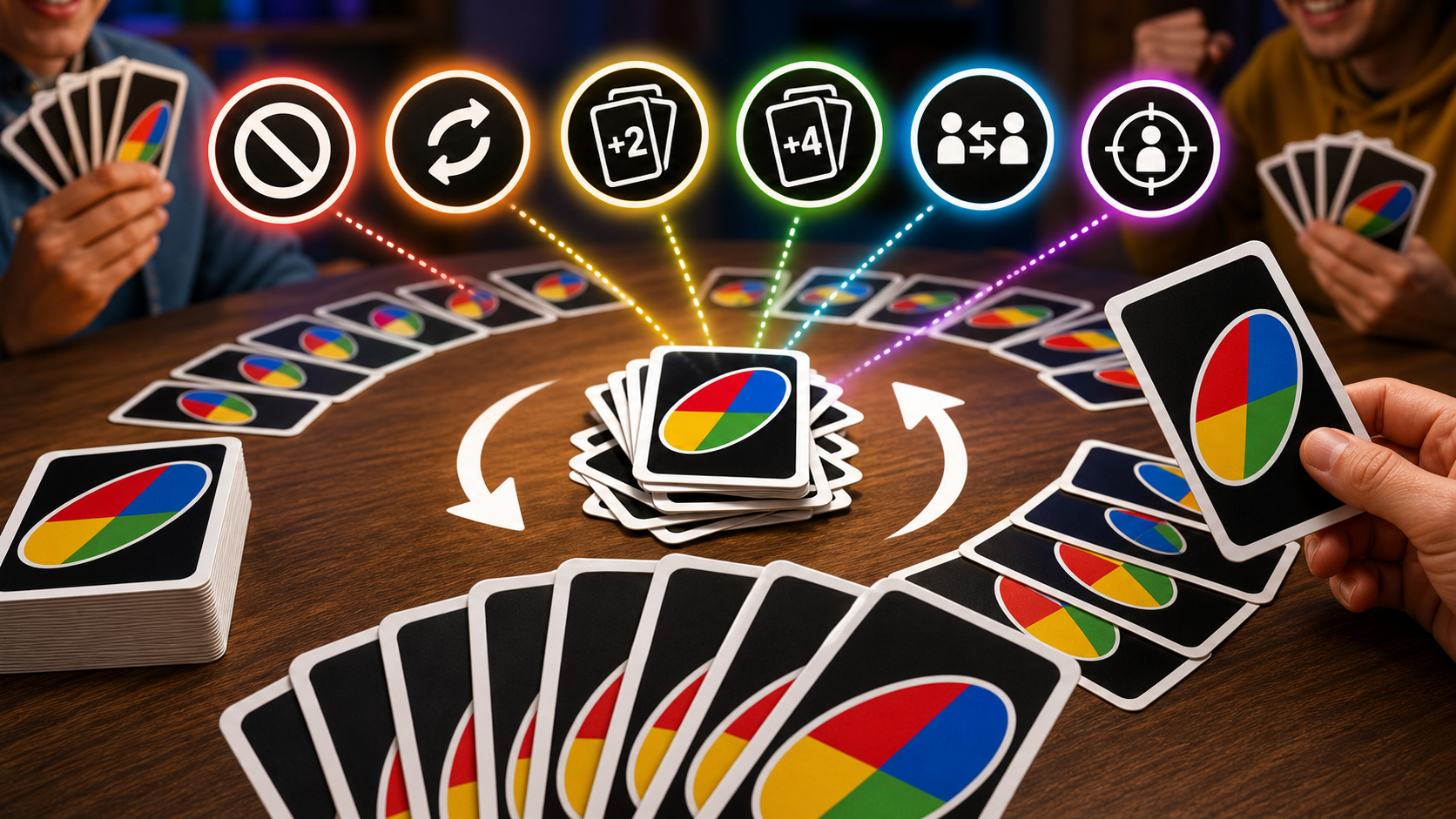
Uno Wild usually refers to UNO All Wild, a faster and more chaotic version of UNO where every card in the deck is wild. That one change transforms the game. In Regular Uno, you spend most turns matching color, number, or symbol. In Uno Wild, you do not need to match color or number because every card can be played. Your turn is almost always simple: play one card, apply its effect if it has one, and keep the round moving.
That does not mean Uno Wild is easier to win. Because every card is playable, the real game is about timing action cards, reading the table, and deciding when to attack, skip, swap, or protect yourself. There are no safe colors to hide behind. If another player is close to going out, almost anyone can interfere. If you are close to going out, the whole table can see it and may use the next action card to slow you down.
This tutorial explains how to play Uno Wild step by step. It covers setup, turn order, the most important wild action cards, calling UNO, scoring, and practical strategy for beginners. It is written for players who know classic UNO as well as people learning this version first.
Uno Wild Setup
Choose a dealer and shuffle the Uno Wild deck thoroughly. Deal seven cards face down to each player. Put the remaining cards face down in the center as the draw pile. Flip the top card of the draw pile face up to create the discard pile. If the first discard is a wild action card, ignore its action for the initial setup and begin play normally. The player to the left of the dealer usually goes first, and play continues clockwise unless a card effect changes the flow.
The object is the same as classic UNO: be the first player to get rid of every card in your hand. The difference is that card matching is removed. You do not ask whether your card matches a color or a number. If it is your turn and you have a card, you can play one. This makes the game move quickly, especially with experienced players. A round can swing from calm to wild in a single turn because action cards are frequent and always playable.
- Deal 7 cards to each player.
- Place the rest of the deck face down as the draw pile.
- Turn over one card to start the discard pile.
- Every card is wild, so matching color or number is not required.
- When you play down to one card, you still must call UNO.
How a Turn Works in Uno Wild
On your turn, play one card from your hand onto the discard pile. If the card has no special action beyond being wild, your turn ends and play moves to the next player. If the card is a wild action card, resolve the action immediately. Because every card is playable, there is usually no reason to draw on your turn unless a card effect tells you to draw or a rare table situation requires it under your group's agreed rules.
This creates a very different rhythm from Regular Uno. In classic play, drawing often happens because a player cannot match the discard pile. In Uno Wild, drawing usually happens because someone made you draw. That means the deck is more aggressive. Players go out faster, but they also get interrupted more often. The game rewards players who understand when to spend a powerful action and when to keep it for a more dangerous moment.
If the draw pile runs out, keep the top card of the discard pile in place, shuffle the rest of the discard pile, and form a new draw pile. Because cards are constantly being played, this may happen in longer games with many players.
Important Uno Wild Action Cards
Uno Wild decks include several action cards that replace the color-and-number puzzle of classic UNO with direct player interaction. The exact names and artwork can vary by edition or region, so always check the instruction sheet that came with your deck. The core idea is consistent: action cards are always playable, and their effects can change turns, hands, and card counts.
A Wild Reverse changes the direction of play. If play was moving clockwise, it now moves counterclockwise. In a two-player game, Reverse often functions like an immediate turn advantage, similar to how classic UNO Reverse can feel like a Skip with only two players. A Wild Skip skips the next player. Some Uno Wild versions include stronger skip effects, such as skipping two players, which can be especially powerful in games with four or more people.
Draw cards are the main way to slow an opponent. A Wild Draw Two or Wild Draw Four forces the next affected player to draw cards and usually lose their turn. Because every card is wild, these draw effects are not restricted by color the way classic Wild Draw Four is. That makes them easier to play and more dangerous. If someone has one card left, a draw card is often the cleanest way to keep them from winning immediately.
Hand-changing cards are where Uno Wild gets especially chaotic. A Wild Swap Hands style card lets a player exchange hands with another player, while a forced swap card may require a specific hand exchange depending on the edition. These cards are strongest when hand sizes are uneven. If you have many cards and another player has one or two, swapping can completely reverse the round. If you are already winning, be careful with swap cards because they may be less useful than a simple skip or draw effect.
Some decks also include targeted wild cards where the player who plays the card chooses another player to draw, skip, or exchange. These cards make table awareness important. Do not automatically attack the player on your left. Attack the player closest to going out, the player with the strongest position, or the player most likely to stop you next.
Calling UNO in Uno Wild
Even though Uno Wild changes the matching rules, it keeps the classic UNO call. When you play your next-to-last card and have exactly one card left, say UNO clearly. If another player catches you before the next player begins their turn, you draw the penalty cards used by your group, commonly two cards. If nobody catches you in time, you continue with one card.
Calling UNO matters more in Uno Wild than many beginners expect. Since every card is playable, a player with one card has a strong chance to win on their next turn. The table should react quickly. If you are next and have a skip, draw, or swap effect that can stop that player, consider using it. If you are the player with one card, expect attention. Sometimes the best path is not simply getting to one card as fast as possible, but getting to one card after the most dangerous action cards have already been spent.
Scoring and Winning Uno Wild
You can play Uno Wild as single quick rounds or as a scored match. For a casual family game, the easiest method is one-round winning: the first player to empty their hand wins. For a longer game night, use match scoring. When a player goes out, add up the value of all cards left in the other players' hands and award that total to the player who won the round. Continue rounds until someone reaches the target score your group chose.
Many UNO games use 500 points as the traditional match target. Card values may vary by deck, so consult the instruction sheet for your exact Uno Wild edition. If you want a simple house system, count basic wild cards at a lower value and powerful action wilds at a higher value, but make that clear before play begins. Consistent scoring matters more than the exact target because Uno Wild rounds can end quickly and points can accumulate fast when players are stuck with large hands.
Beginner Strategy for Uno Wild
The first strategy lesson is that card count matters more than color control. In Regular Uno, changing the color can protect you. In Uno Wild, there are no colors to control in the same way. Instead, watch how many cards each player has and what kind of actions might stop them. If a player has two cards, they are dangerous. If a player has one card, they are urgent. Save at least one disruptive action for those moments when possible.
The second lesson is to avoid wasting swap cards. A swap card is weak when all players have similar hand sizes. It is powerful when you can trade a large hand for a small one or force a leader to take a large hand. If you draw a swap card early, holding it can be better than playing it immediately. The best moment often comes after another player has reduced their hand but before they can go out.
The third lesson is to think about turn order. A Skip is not equally valuable against every player. Skipping someone with six cards may do little. Skipping someone with one card may save the round. Reverse can also be defensive. If the next player is about to win, reversing direction may push the turn away from them. If the previous player has one card, reversing may hand them the win, so check both sides before you play.
The fourth lesson is to expect retaliation. Uno Wild feels more direct than classic UNO because attacks are easy to play. If you repeatedly target one player, they may target you back. In friendly games, this is part of the fun. In strategic games, spreading disruption can be smarter unless one player is clearly ahead. Your goal is not to punish randomly; your goal is to create a turn where you can play your final card before anyone can stop you.
Uno Wild vs Regular Uno
Regular Uno is about matching and managing colors. Uno Wild is about tempo and action timing. In Regular Uno, a weak hand may become playable if the color changes. In Uno Wild, every hand is playable, so weak and strong hands are defined by action effects and hand size. Regular Uno often has more quiet turns. Uno Wild has fewer quiet turns because nearly every card can change the table.
Choose Regular Uno when you want the classic experience, more suspense around whether someone can play, and a familiar ruleset for mixed-age groups. Choose Uno Wild when you want a faster game with more interaction and fewer pauses. Both games share the same core thrill: empty your hand, watch the table react, and remember to shout UNO before someone catches you.
Frequently Asked Questions
Is Uno Wild the same as UNO All Wild?
Most players use Uno Wild to mean UNO All Wild, the version where every card is wild and players do not match colors or numbers.
Do you have to match colors or numbers in Uno Wild?
No. In UNO All Wild, every card is wild, so you can play a card on your turn without matching a color or number.
Do you still say UNO in Uno Wild?
Yes. When you have one card left, you still need to say UNO. If another player catches you before the next turn begins, you take the agreed penalty.