UNO Rules Tutorial
How to Play Regular Uno: Complete Classic UNO Rules for Beginners
Learn how to play Regular Uno with clear setup steps, turn rules, action cards, scoring, winning conditions, and beginner strategy tips for classic UNO.
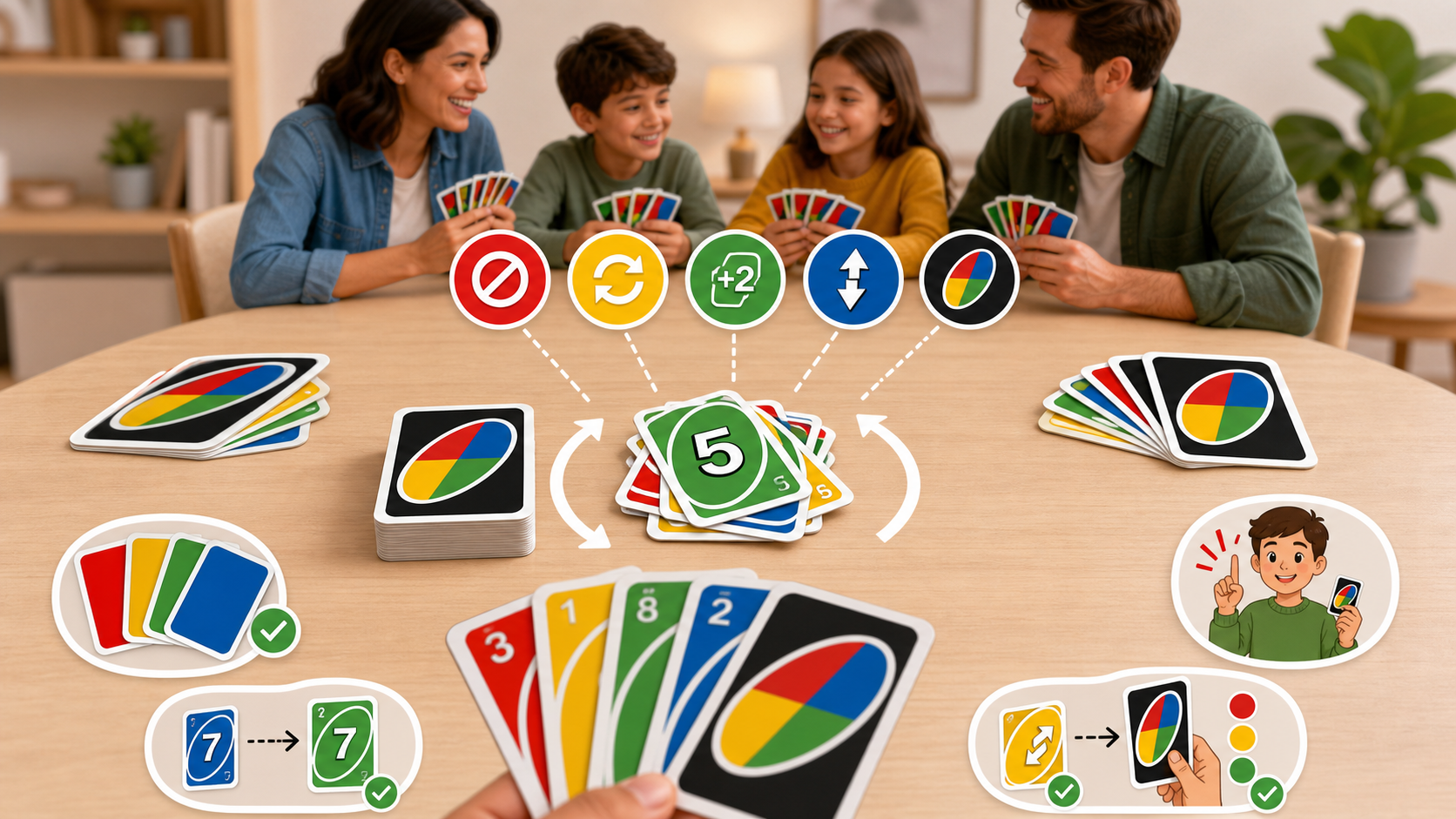
Quick Answer: What Is Regular Uno?
Regular Uno, often called Classic UNO, is a fast matching and shedding card game for groups of friends and families. The goal is simple: be the first player to get rid of every card in your hand. You do that by matching the top card on the discard pile by color, number, or symbol, while action cards such as Skip, Reverse, Draw Two, Wild, and Wild Draw Four interrupt the rhythm of play. The game is easy to teach in a few minutes, but every round creates small tactical decisions about timing, color control, and when to hold or spend powerful cards.
This guide explains how to play Regular Uno from the first shuffle to the final score. It follows the core structure of the official classic UNO rules while using plain English examples for beginners. If you are teaching new players, the most important ideas are these: deal seven cards to each player, match the discard pile when you can, draw when you cannot play, shout UNO when you have one card left, and score the cards left in everyone else's hands when a player goes out.
Regular Uno Setup
A standard Regular Uno deck contains four colors: red, yellow, green, and blue. Each color includes number cards and three kinds of colored action cards: Draw Two, Reverse, and Skip. The deck also includes black Wild cards and Wild Draw Four cards. Most classic decks have 108 cards, although some newer or themed decks may include extra customizable cards. For a normal game, set aside any blank or special cards unless everyone agrees to use them before the round starts.
Choose a dealer. The dealer shuffles the full deck and deals seven cards face down to each player. Players may look at their own cards, but they should keep them hidden from everyone else. Put the remaining deck face down in the center as the draw pile. Flip the top card of the draw pile face up next to it to begin the discard pile. The player to the left of the dealer usually takes the first turn, and play begins clockwise unless the first card or a Reverse card changes that direction.
- Players: commonly 2 to 10.
- Starting hand: 7 cards per player.
- Goal of each round: empty your hand first.
- Main match rule: play a card matching the discard pile by color, number, or symbol.
- Important table rule: say UNO when you play down to one card.
How a Turn Works
On your turn, look at the top card of the discard pile. You may play one card from your hand if it matches the top discard by color, number, or symbol. For example, if the top card is a red 7, you may play any red card, any 7 of another color, or a Wild card. If the top card is a green Skip, you may play another green card, another Skip card, or a Wild card. Symbols matter because action cards match other action cards with the same symbol, even if the color is different.
If you do not have a playable card, draw one card from the draw pile. If the card you draw can be played immediately, many tables allow you to play it right away under the official style of play. If it cannot be played, keep it and your turn ends. A common house rule forces a player to keep drawing until they find a playable card, but that is not the standard Regular Uno rule. If you want a smooth game, agree on the draw rule before you start.
After a player plays a card, the next player takes their turn unless the card played changes the turn order, skips someone, or forces someone to draw. Play continues around the table until one player has no cards left. If the draw pile runs out before the round ends, take the discard pile, leave the top card in place, shuffle the rest, and create a new draw pile.
Regular Uno Action Cards Explained
Action cards are what make Regular Uno more than a simple matching game. A Skip card makes the next player lose their turn. A Reverse card changes the direction of play from clockwise to counterclockwise or back again. In a two-player game, Reverse often works much like Skip because play immediately returns to the person who played it. A Draw Two card makes the next player draw two cards and lose their turn. Draw Two cards are colored, so they can be played when they match the current color or when another Draw Two is showing.
A Wild card can be played on almost any turn. When you play it, choose the color that continues the game. Good players do not pick randomly. They choose a color that gives them the best chance to play again soon, or a color that they suspect will hurt the next player. A Wild Draw Four card is stronger and more restricted. It lets you choose the next color, and the next player draws four cards and loses their turn. Under official rules, you should only play Wild Draw Four when you do not have a card in your hand that matches the current color. You may still have matching numbers or action symbols in other colors, but if you have the current color, the Wild Draw Four is not legally available.
Because Wild Draw Four is so powerful, UNO includes a challenge rule. If someone thinks you played it illegally, they may challenge. If you were holding a card that matched the current color, you must draw four instead. If the Wild Draw Four was legal, the challenger usually draws extra cards. Many casual groups skip challenges to keep the game simple, but knowing the rule prevents arguments in competitive games.
Calling UNO and Going Out
The word UNO matters. When you play your second-to-last card and have one card remaining, you must call out UNO before another player catches you. If you forget and another player calls attention to it before the next player begins their turn, you draw two penalty cards. If nobody catches you in time, you continue with one card. This rule creates one of the most memorable moments in the game because everyone watches closely when another player gets near the end.
A round ends when a player plays their final card. If the final card is an action card, its effect still applies for scoring in many official-style games. For example, if someone goes out with a Draw Two, the next player draws two cards before points are counted. If someone goes out with a Wild Draw Four, the next player draws four before scoring. Casual groups sometimes ignore the final action because the round is already over, but using the action keeps the scoring consistent with the card that actually ended the round.
Scoring and Winning Regular Uno
You can play Regular Uno as a single round, where the first player to empty their hand wins, or as a scored match. In classic scoring, the player who goes out earns points for every card left in opponents' hands. Number cards are worth their face value. Draw Two, Reverse, and Skip are commonly worth 20 points each. Wild and Wild Draw Four are commonly worth 50 points each. Add the total to the winner's running score.
The traditional match target is 500 points. The first player to reach that total wins the match. There is also an alternate scoring style where each player receives points for cards left in their own hand, and the lowest score wins after someone reaches a target. For family play, the simplest system is often best: play one round for quick fun, or use the 500-point method if you want a longer game night with clear stakes.
Beginner Strategy for Regular Uno
The biggest beginner mistake is playing every action card as soon as possible. Sometimes that works, but Regular Uno rewards timing. Save a Wild card if your hand has many different colors and you might need an escape later. Spend a Wild earlier if you are trapped with one color and need control now. If you have several cards of the same color, try to keep the game on that color. If you know the player after you has only one card, use Skip, Reverse, Draw Two, or Wild Draw Four to stop them if you can.
Pay attention to colors that players cannot play. If someone draws on blue and keeps the card, they may not have blue. If you can choose a color later, blue might be a smart choice against that player. Also watch when someone says UNO. Their last card has a color or symbol they were willing to keep. If you can change the color immediately, you reduce their chance of going out.
For new players, the best way to learn is to play openly for the first few turns. Explain why a card is legal, why an action happens, and why the direction changes. After one round, most players understand the flow. Regular Uno stays popular because the rules are light enough for beginners but interactive enough that every turn can shift the table.
Frequently Asked Questions
How many cards do you start with in Regular Uno?
Each player starts with seven cards. The rest of the deck becomes the draw pile, and one card is flipped over to start the discard pile.
Can you play a Wild Draw Four anytime?
Under the classic rule, you should only play Wild Draw Four when you do not have a card matching the current color. Many casual groups use looser house rules, but players should agree before the game starts.
What happens if you forget to say UNO?
If another player catches you before the next player begins their turn, you draw two cards. If nobody catches you in time, there is no penalty.